


Rubber Delta fenders Brochure
In our download section you will find the latest editions of our fender brochures.
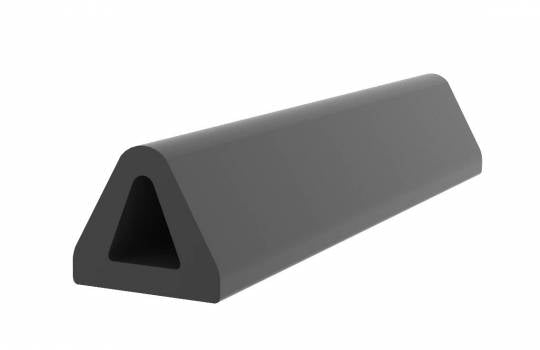
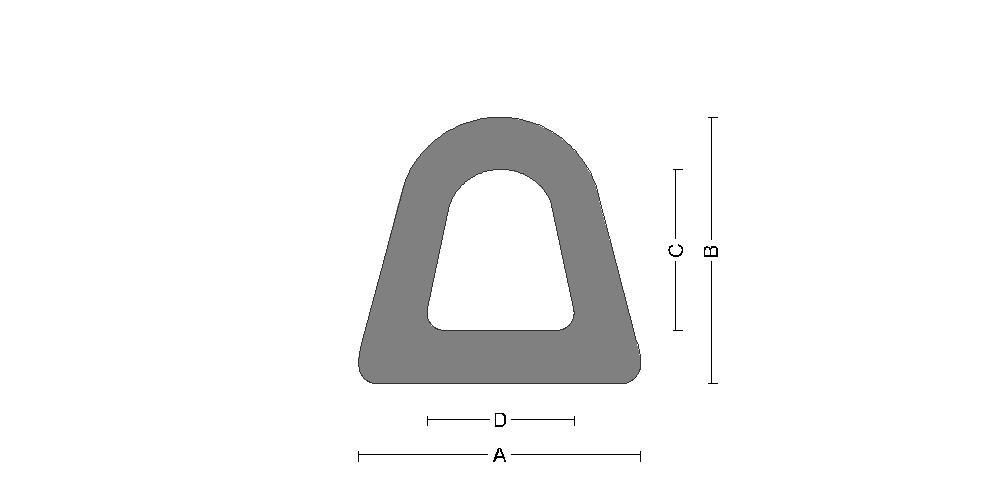
| Product Name | SKU | A (mm) | B (mm) | C (mm) | D (mm) | Weight (kg/m) | Max Length (mm) |
|---|---|---|---|---|---|---|---|
| Delta-fender 060x050mm bore 40x30mm | DEL060050 | 60 | 50 | 40 | 30 | 2,2 | 25.000 |
| Delta-fender 080x070mm bore 43x40mm | DEL080070 | 80 | 70 | 43 | 40 | 3,5 | 12.500 |
| Delta-fender 080x075mm bore 45x40mm | DEL080075 | 80 | 75 | 45 | 40 | 3,1 | 12.500 |
| Delta-fender 110x100mm bore 65x68mm | DEL110100 | 110 | 100 | 65 | 68 | 7,4 | 12.500 |
| Delta-fender 150x130mm bore 80x75mm | DEL150130 | 150 | 130 | 80 | 75 | 13,5 | 6.000 |
Typical applications:
-

Rubber fenders for ships
What are ship fenders? Ship fenders are marine protection systems designed to...
-

Quay fenders
What are quay fenders? Quay fenders are marine protection systems installed along...
-

Fenders for Pontoons and marinas
FenderTec specializes in supplying powerful and high-quality pontoon fenders and / or...


Rubber Delta fenders information:
FAQ
What are Delta Fenders?
Delta Fenders are profiled rubber fendering products designed to protect structures and equipment from impact and abrasion in industrial and marine environments. They provide a resilient interface that reduces transmitted forces and limits surface damage by absorbing and distributing energy. These Delta rubbers are selected for applications that require compact, energy-absorbing protection. For application-specific selection or compatibility questions, contact our technical team for advice.
What are Delta rubbers used for?
Delta rubbers are used as impact-absorption and edge-protection profiles across sectors such as material handling, transport and infrastructure. They reduce wear at contact points, dampen collision noise and help prevent structural damage by dissipating kinetic energy. Delta protection profiles can also function as resilient sealing or buffering elements where repeated contact occurs. For recommendations on the appropriate profile for a particular duty cycle or environment, contact our technical team.
How do Delta protection profiles absorb impact?
Delta protection profiles absorb impact through elastic deformation of the rubber compound, which dissipates kinetic energy and reduces peak forces transmitted to adjacent structures. The material compresses under load and partially recovers when the load is removed, enabling repeated energy absorption without immediate deterioration. Actual performance depends on compound properties, profile geometry and operating conditions. For guidance on expected behaviour in specific environments or under particular loads, contact our technical team.
How do I choose the right Delta fender for my application?
Choosing the right Delta fender requires consideration of impact severity, mounting method, surface compatibility, environmental exposure and maintenance requirements. Assess the expected loads, chemical or temperature exposure and whether a resilient sealing or purely buffering function is required. Material compatibility with adjoining surfaces and the preferred fixing arrangement also influence selection. For tailored advice on selecting a Delta protection profile that matches operational conditions, contact our technical team.
Fender brochures
In our download section you will find the latest editions of our fender brochures. Please download our latest fender catalogue for more interesting product information