


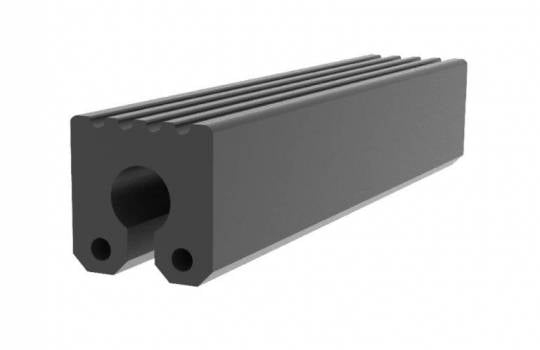
Keyhole fenders ribbed Brochure
In our download section you will find the latest editions of our fender brochures.
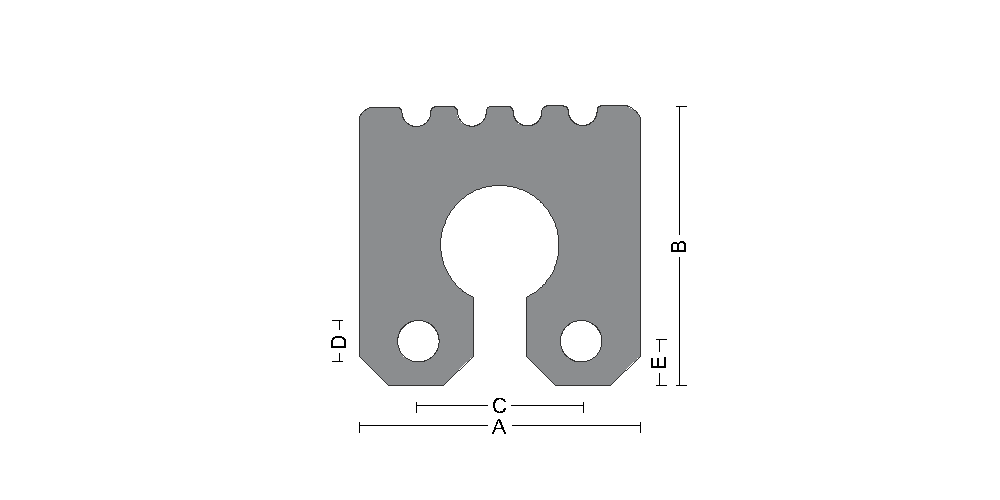
| Product Name | SKU | A (mm) | B (mm) | C (mm) | D (mm) | Weight (kg/m) | Max Length (mm) |
|---|---|---|---|---|---|---|---|
| Keyhole fender ribbed face 100x100mm | KEYR100100 | 100 | 100 | 70 | 16 | 8,0 | 2.000 |
| Keyhole fender ribbed face 200x200mm | KEYR200200 | 200 | 200 | 130 | 28 | 33,0 | 2.000 |
| Keyhole fender ribbed face 250x250mm | KEYR250250 | 250 | 250 | 150 | 33 | 54,0 | 2.000 |
| Keyhole fender ribbed face 300x300mm | KEYR300300 | 300 | 300 | 180 | 33 | 80,0 | 2.000 |
| Keyhole fender ribbed face 350x350mm | KEYR350350 | 350 | 350 | 210 | 33 | 114,0 | 2.000 |
Related tugboat fenders:
-

Fenders for Tugboats
FenderTec produces high-quality rubber fenders for workboats, tugboats, and marine applications. We...

Keyhole fenders ribbed information:
FAQ
What is a Keyhole fender?
A Keyhole fender is a marine fender designed with a keyhole-shaped opening to engage a mounting post or pin. It is a rubber or elastomeric component used to absorb and distribute impact energy between a vessel and a berth, vessel and vessel, or between pushing units and pushed units. Keyhole fenders are used where a secure, low-profile attachment is required to keep the fender aligned during berthing and manoeuvring operations.
What are Keyhole fenders used for?
Keyhole fenders are used to protect hulls, berthing structures and pushing interfaces by absorbing impact energy and reducing localized loads. They are commonly applied on tugboats and as pushing stern fenders where repeated contact occurs between vessels. The fenders help to prevent structural damage, reduce shock transmission and provide a resilient contact surface during mooring, towing and ship-to-ship operations. Contact our team for technical advice on selecting the appropriate fender type for a given application.
What is a ribbed Keyhole fender?
A ribbed Keyhole fender incorporates longitudinal or circumferential ribs on its contact face to improve grip and wear characteristics. The ribbed profile can reduce sliding during contact, increase surface area for energy distribution and assist in channelling water and debris away from the contact zone. Ribbed Keyhole fenders are chosen where enhanced abrasion resistance and controlled contact behaviour are required. For guidance on whether a ribbed profile suits your vessel or structure, consult our technical team.
How are Keyhole fenders installed?
Keyhole fenders are installed by engaging the keyhole opening onto a compatible mounting pin, boss or rail system designed to retain the fender under load. Proper installation requires a matching mounting geometry, adequate backing structure and secure fastenings to prevent displacement during operations. After installation, regular inspection and maintenance are recommended to verify attachment integrity and material condition. For installation recommendations and compatibility checks, please contact our team for technical assistance.
Fender brochures
In our download section you will find the latest editions of our fender brochures. Please download our latest fender catalogue for more interesting product information