


Rubber keyhole fender blocks Brochure
In our download section you will find the latest editions of our fender brochures.
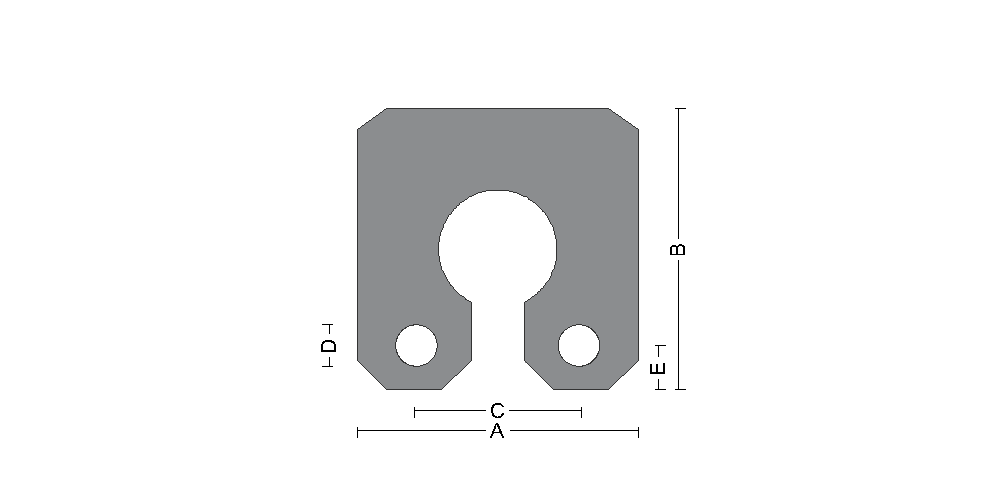
| Product Name | A (mm) | B (mm) | C (mm) | D (mm) | E (mm) | Weight (kg/m) | Max Length (mm) |
|---|---|---|---|---|---|---|---|
| Keyhole fender block flat face 100x100mm | 100 | 100 | 70 | 16 | 16 | 8 | 6000 |
| Keyhole fender block flat face 150x150mm | 150 | 150 | 100 | 18 | 35 | 19 | 2000 |
| Keyhole fender block flat face 200x200mm | 200 | 200 | 130 | 28 | 35 | 33 | 2000 |
| Keyhole fender block flat face 250x250mm | 250 | 250 | 150 | 33 | 50 | 54 | 2000 |
| Keyhole fender block flat face 300x300mm | 300 | 300 | 180 | 33 | 60 | 80 | 2000 |
| Keyhole fender block flat face 350x350mm | 350 | 350 | 210 | 33 | 70 | 114 | 2000 |
Rubber keyhole fender blocks information:
FAQ
What is a rubber keyhole fender?
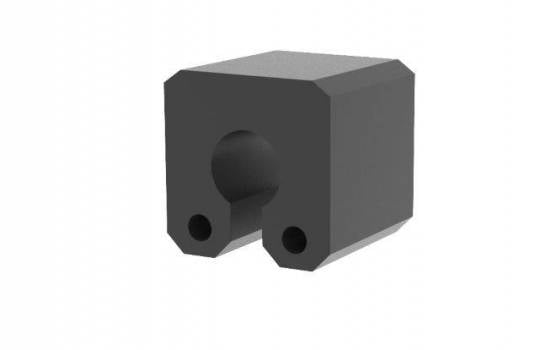
A rubber keyhole fender is a marine fender with a recessed, keyhole-shaped profile manufactured from elastomeric rubber. It is designed to absorb and distribute impact energy between vessels or between a vessel and a quay. This fender type is commonly used on tugboats and work boats where controlled compression and energy dissipation are required. The rubber construction provides resilience and resistance to abrasion while helping to protect hulls and berthing structures during contact operations.
What are keyhole fenders used for?
Keyhole fenders are used to protect vessels and fixed structures during berthing, towing and pushing operations. They are frequently applied as tugboat fenders and pushing stern fenders where concentrated contact forces occur. In quay and harbor applications they serve to reduce impact loads on both the vessel and the quay face. Their design is intended to manage repetitive impacts while minimising transfer of shock to hulls and structures.
How are keyhole fenders installed?
Keyhole fenders are typically fixed to vessels or quay structures using appropriate mechanical fastenings and backing arrangements compatible with the installation surface. Mounting methods depend on the application and the mounting substrate; installations on tugboats and quay faces often require reinforced backing plates or structural supports to distribute loads. Installation should follow manufacturer guidance and engineering assessment. Contact our team for technical advice on suitable fixing methods for your specific vessel or quay configuration.
What maintenance do rubber keyhole fenders require?
Maintenance for rubber keyhole fenders focuses on regular inspection, cleaning and securement checks. Inspections should verify the integrity of the rubber body, look for excessive abrasion, cuts or deformation, and confirm that fixings and any backing plates remain secure. Cleaning to remove debris and contaminants helps maintain material performance. Where damage or progressive wear is observed, replacement or repair should be arranged. For application-specific maintenance recommendations, contact our team for guidance.

Fender brochures
In our download section you will find the latest editions of our fender brochures. Please download our latest fender catalogue for more interesting product information