


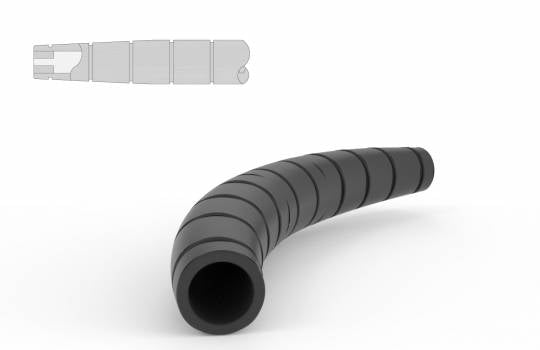

Cylindrical bow fenders Brochure
In our download section you will find the latest editions of our fender brochures.
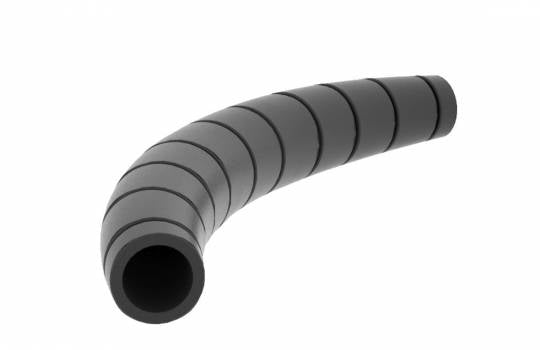
| Product Name | SKU | A (mm) | B (mm) | C (mm) | D (mm) | Weight (kg/m) | Max Length (mm) |
|---|---|---|---|---|---|---|---|
| Bow and Stern fender 0250x125mm | BOW0250125 | 250 | 125 | 200 | 570 | 45,5 | 8.500 |
| Bow and Stern fender 0300x150mm | BOW0300150 | 300 | 150 | 225 | 600 | 65,2 | 8.500 |
| Bow and Stern fender 0380x190mm | BOW0380190 | 380 | 190 | 280 | 650 | 105,0 | 1.000 |
| Bow and Stern fender 0400x200mm | BOW0400200 | 400 | 200 | 300 | 670 | 116,0 | 1.000 |
| Bow and Stern fender 0450x225mm | BOW0450225 | 450 | 225 | 300 | 700 | 147,0 | 8.500 |
| Bow and Stern fender 0500x250mm | BOW0500250 | 500 | 250 | 300 | 730 | 181,0 | 8.400 |
| Bow and Stern fender 0600x300mm | BOW0600300 | 600 | 300 | 350 | 800 | 255,0 | 10.000 |
| Bow and Stern fender 0800x400mm | BOW0800400 | 800 | 400 | 350 | 930 | 453,0 | 11.700 |
| Bow and Stern fender 0900x450mm | BOW0900450 | 900 | 450 | 350 | 1.000 | 573,0 | 10.500 |
| Bow and Stern fender 1000x500mm | BOW1000500 | 1.000 | 500 | 350 | 1.060 | 707,0 | 12.500 |
Related tugboat fenders:
-

Fenders for Tugboats
FenderTec produces high-quality rubber fenders for workboats, tugboats, and marine applications. We...

Cylindrical bow fenders information:
FAQ
What are cylindrical bow fenders used for?
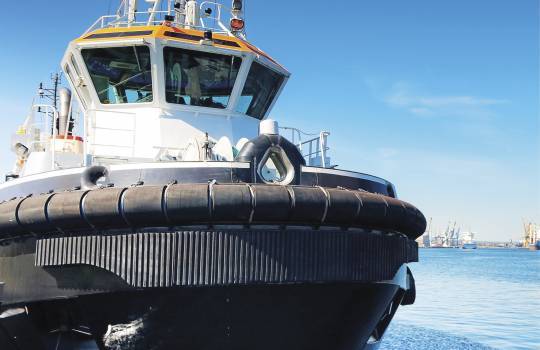
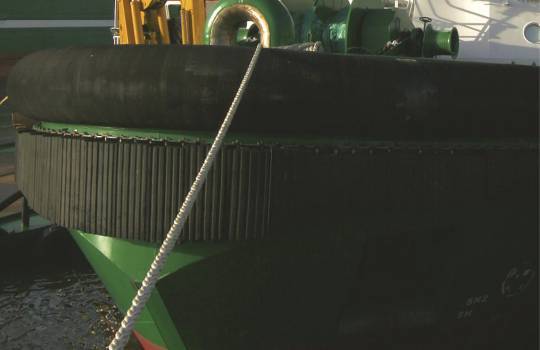
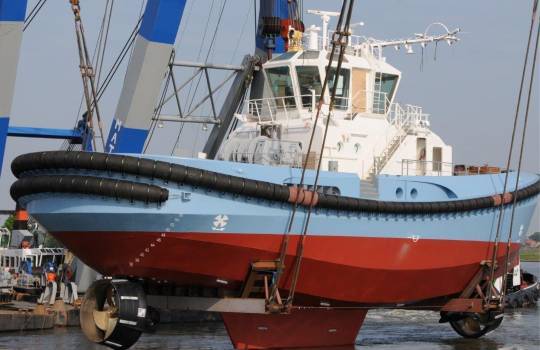
Cylindrical bow fenders are marine cushioning devices designed to absorb impact and prevent damage to a vessel’s hull during mooring, berthing, or close-quarter contact with docks and other vessels. They are typically positioned at the bow but can be used along the hull where a continuous contact surface is needed. These fenders perform a similar protective role to Stern Fenders when mounted aft; their cylindrical shape provides even distribution of contact forces and controlled deflection under load.
How do cylindrical bow fenders differ from stern fenders?
The primary difference is typical placement and contact conditions. Cylindrical bow fenders are often used at the bow to manage head-on or angled impacts and to provide a rolling contact surface; stern fenders are positioned at the transom to protect the stern during docking or when vessels come alongside. Functionally both types protect the hull, but selection depends on contact geometry, mounting arrangement, and the area of the hull requiring protection. The same cylindrical form may be used fore or aft depending on operational needs.
What materials are cylindrical fenders made of and how should I choose one?
Cylindrical fenders are commonly produced from elastomeric or polymeric materials such as molded rubber, synthetic elastomers, or foam cores with a protective skin. Material choice affects energy absorption, abrasion resistance, UV resistance, and long-term flexibility. Selection should be based on the vessel’s operating environment, expected impact severity, and maintenance preferences. For application-specific guidance and material recommendations that match operational conditions, contact our team for technical advice.
How should cylindrical bow fenders be installed and maintained?
Installation typically involves securing the fender to strong points on the vessel or berth using appropriate lines, chafing protection and mounting hardware rated for marine use. Positioning should ensure the fender contacts the expected impact zone without impeding vessel operations. Maintenance includes routine inspection for cuts, deformation, loss of integrity, and wear of attachment gear; cleaning with fresh water and mild detergent; and replacing fenders that show significant damage. For tailored installation or maintenance recommendations, consult our team for professional advice.
Fender brochures
In our download section you will find the latest editions of our fender brochures. Please download our latest fender catalogue for more interesting product information